
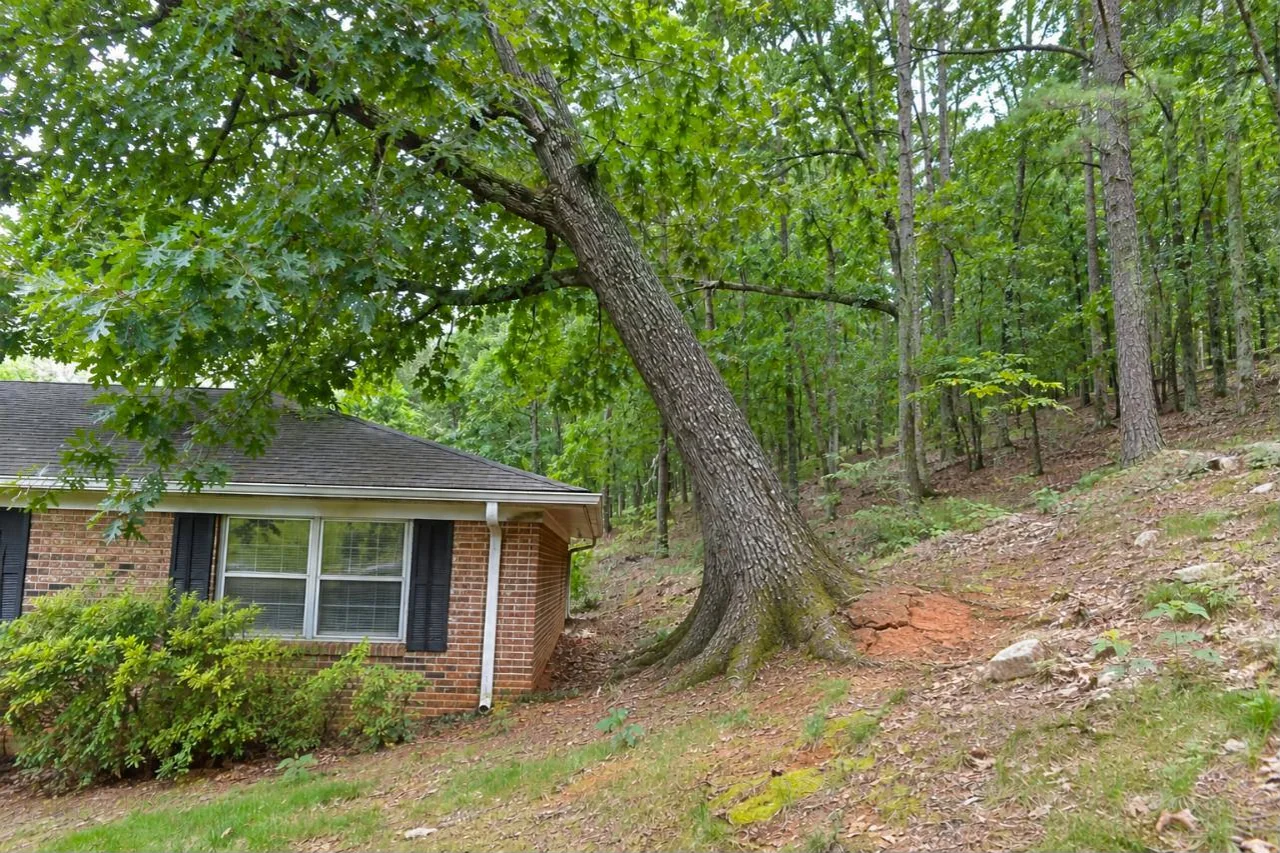
A lean that wasn't there before
Lots of trees grow at an angle, reaching toward light at the edge of the woods, and stand that way for decades. Their roots and trunk have grown to carry the weight. A tree that starts to lean after a storm or a long wet spell is a different thing: something has moved below ground.
Signs that the roots are letting go:
- Soil cracked, lifted or mounded on the side away from the lean, like the clay at the base of the oak above.
- Roots showing at the surface that weren't before, or a gap opening between the trunk and the ground.
- A lean you can see getting worse from one week to the next, or after each storm.
- A crown suddenly closer to the roof, a wire or the neighbor's house than it was.
Any of those on a tree that could reach the house is a reason to call now, not after the next round of storms. Until it's handled, keep people and cars out of the area the tree could reach if it went over.
Why ground matters here
Some trees here root shallow by nature. The USDA's Silvics Manual says water oak "has a shallow, spreading rooting habit," and that young loblolly pines give up their short taproot "in favor of an extensive lateral-root system." The Forest Service adds that loblolly is "relatively windfirm where soils are deep, but windthrow is common on shallow soils."
The county's own ground can work against them. On the ridges, soils typical of this Valley and Ridge country sit only 10 to 40 inches over shale or sandstone, by the USDA's official soil descriptions, though which of them are mapped on any given St. Clair County lot wasn't confirmed for this site. On low ground, the Tanyard soil, whose type location is about 2.5 miles northwest of Pell City, has a water table 1.5 to 2.5 feet down in winter and early spring. Shallow rock and a high water table both limit how deep roots can go, and a tree rooted in a thin layer has less to hold it when wet clay softens and the wind blows. On a hillside, a tree uphill of the house that starts to go has gravity working with it.
Water oaks that go hollow
Water oak grows fast and dies young. UF/IFAS gives it a life span of only 30 to 50 years on good sites, calls it "susceptible to breakage," and says it's poor at sealing off decay, so many are hollow by about age 40 and often begin falling apart just as they reach a size people like. Its heavy side limbs "can split from the tree in wind storms." In UF/IFAS hurricane studies it lands in the lowest wind-resistance group.
The USDA's Silvics Manual lists trunk canker and heart rot from a variety of organisms in water oak, and root rot from Ganoderma curtisii. UF/IFAS adds mushroom root rot and trunk decay as serious problems and says shoestring root rot has "no practical control."
What a homeowner can see: cavities in the trunk or at old limb wounds, mushrooms or shelf-like growths at the base, dead limbs high in the crown, and pieces of the tree dropping in ordinary wind. A big water oak showing those signs over a house, a driveway or a play area is usually a removal job.
Ash and the emerald ash borer
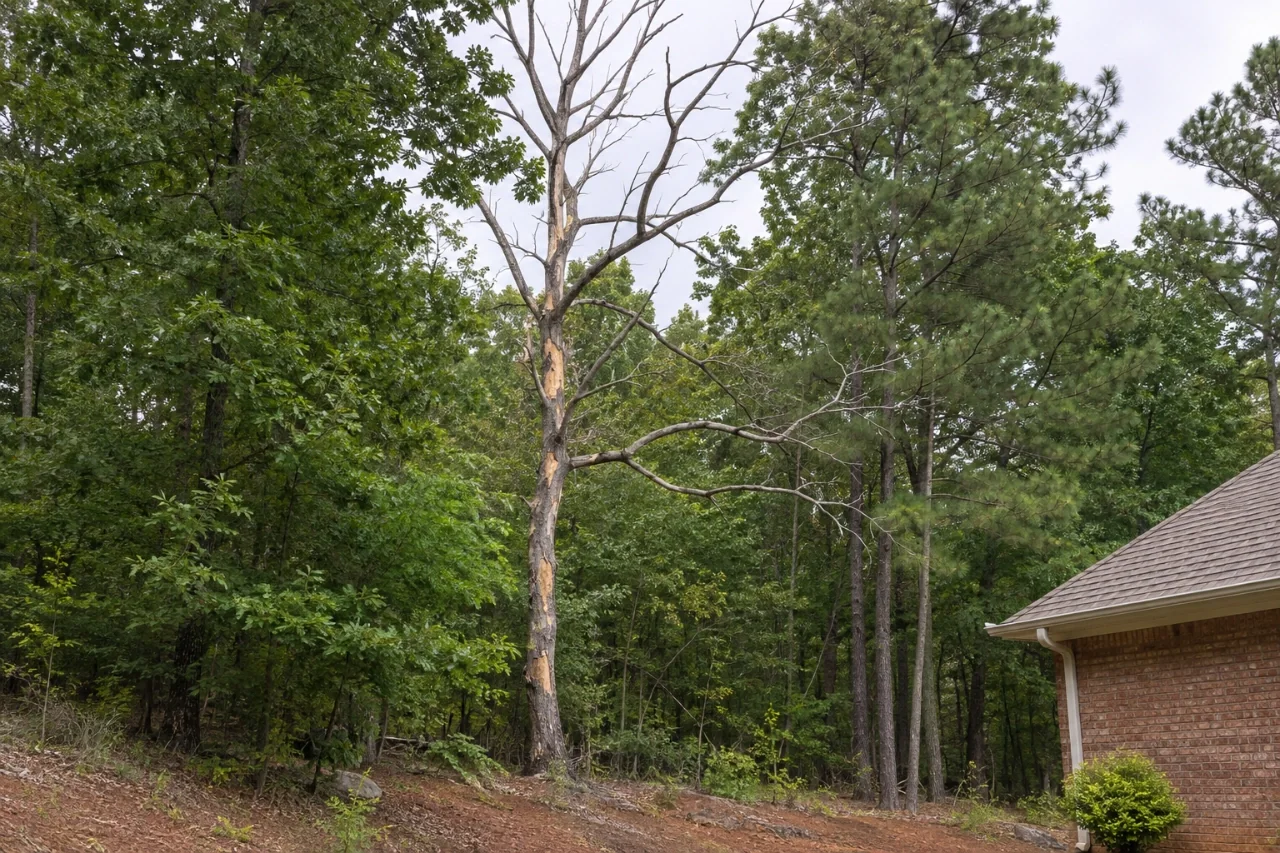
The Alabama Forestry Commission says it has documented emerald ash borer in St. Clair County, along with Etowah, Calhoun, Talladega and Shelby, and in a post dated June 6, 2025 it added new confirmations in Jackson and Madison counties. The beetle was first confirmed in Alabama in Calhoun County in the mid-2010s, and by 2017 the USDA Forest Service's state report noted symptomatic ash trees in Calhoun, Talladega and St. Clair.
Alabama Extension explains how it goes: the infestation works down the trunk over two to four years, and the D-shaped exit holes the adult beetles leave in the bark are "a classic calling card left by this insect." Ash makes up only about one percent of Alabama's trees, so this is a smaller problem than pine beetles, but an ash that dies beside a house still has to come down.
For the wood, the Forestry Commission says infested ash that's been cut down "should preferably be burned or destroyed on-site." Burning on a house lot runs into ADEM's open-burning rule, which requires 500 feet from the nearest occupied dwelling (checked Nov 12, 2026), so ask the contractor how the ash will be handled.
Oaks and pines after a drought
The 2016 drought showed what dry years do here. The USDA Forest Service's Alabama forest health report for 2017 noted red oaks in northern Alabama starting to decline by late summer of 2016, and by late winter "some of the drought-affected hardwoods were succumbing to Hypoxylon canker." It went on: "Most of these red oaks were infected with Hypoxylon canker." In October 2016, a drought emergency declaration banned outdoor burning in 46 north and central Alabama counties.
Pines suffered too. The same report's southern pine beetle surveys found 2,322 spots infesting 212,135 pines, and said drought-related beetle attacks were killing pines across Alabama, "especially in the northern areas of the state," with pines on steep slopes or shallow soils especially vulnerable. A tree that limps out of a drought year with thin leaves and dead limbs high in the crown deserves a look the following spring.
After a lightning strike
Alabama Extension's guide to lightning-struck trees counts nearly one million cloud-to-ground strikes a year in Alabama, about 6% of them hitting trees, which works out to some 60,000 trees a year. "The tallest trees—single specimens in open fields or trees on hilltops—have the greatest potential for strikes," it says. On a ridge lot that's often the big pine behind the house.
Its advice on whether to remove a struck tree:
- Remove it if more than about a third of the canopy has been blasted away and the trunk is badly scarred, if the trunk has split, or if deep cracks run through the wood, especially near homes or driveways.
- Otherwise, wait several weeks and watch the crown.
- For pines, act quickly against bark beetles, which bore into trees weakened by lightning.
Pines browning from the top
The Alabama Forestry Commission says the first sign of southern pine beetle attack is usually yellowing or browning needles, and a full attack cycle takes 25 to 40 days depending on temperature. Alabama Extension adds the other giveaways: small, popcorn-like lumps of dried resin on the bark, and reddish boring dust in the bark crevices. The loblolly pine guide covers the signs, the risk to nearby pines and what Extension recommends.
Dead trees near the lines
A dead tree leaning toward an overhead line is Alabama Power's business as much as yours. The company says no one should climb trees near power lines, that people without line training need to keep 10 feet from lines under 50,000 volts, and that pruning around lines should be left to qualified professionals. Homeowners can ask for a look through its online tree-trimming form, and it says a representative will reach you within 5 to 7 business days (checked Nov 12, 2026). If the tree is already on the line, call 1-800-888-2726.
Questions about failing trees near Pell City
The dead tree is far from the house. Can it stay?
Often, yes. A dead tree in the woods that can't reach a house, a road, a fence, a driveway or a path is a judgment call. The question is always what it would hit, and whether people walk under it.
My oak started leaning after the last storm. How soon should it be looked at?
Right away if it could reach the house, especially if the ground at its base has cracked or lifted. Keep people out of its reach until a contractor has seen it.
Can I remove a dead tree at the water on my Logan Martin lot?
Not inside the 15-foot buffer on Alabama Power's land without the company's written authorization. Its guidelines make no exception for dead trees. Call the Logan Martin Lake Office at 205-472-0481 (checked Nov 12, 2026), and see the lake lot guide.
The dead tree is on my neighbor's side of the line. What can I do?
Talk to the neighbor. Cutting trees on someone else's land without consent can make you owe them a set sum for each tree under Ala. Code § 35-14-1 (checked Nov 12, 2026), so the owner should agree to the work first.
This site doesn't assess or cut trees. A request sent from it reaches one independent contractor who works in Pell City and around St. Clair County.
Source notes
- NWS Birmingham, Morning Straight Line Wind Damage on April 27, 2011. Checked Nov 12, 2026.
- USDA Silvics Manual, Quercus nigra and Pinus taeda; USDA Forest Service Fire Effects Information System, Pinus taeda; UF/IFAS, Quercus nigra: Water Oak (ST553) and Wind and Trees (FR173).
- USDA official soil series descriptions: Tanyard, Montevallo, Townley and Gorgas.
- Alabama Forestry Commission, emerald ash borer news post (June 6, 2025) and Southern Pine Bark Beetle; Alabama Extension, Down South: The Emerald Ash Borer in Alabama, Managing Pine Bark Beetles in Urban Forests (FOR-2049) and Caring for Lightning-Struck Trees (FOR-2134, May 2023). Checked Nov 12, 2026.
- USDA Forest Service, Alabama Forest Health Highlights 2017 and 2022.
- Alabama Power, Trees and Rights of Way and Residential Vegetation Management; Alabama Power shoreline guidelines and contacts; Ala. Admin. Code r. 335-3-3-.01; Ala. Code § 35-14-1 (2025 Code). Checked Nov 12, 2026.