
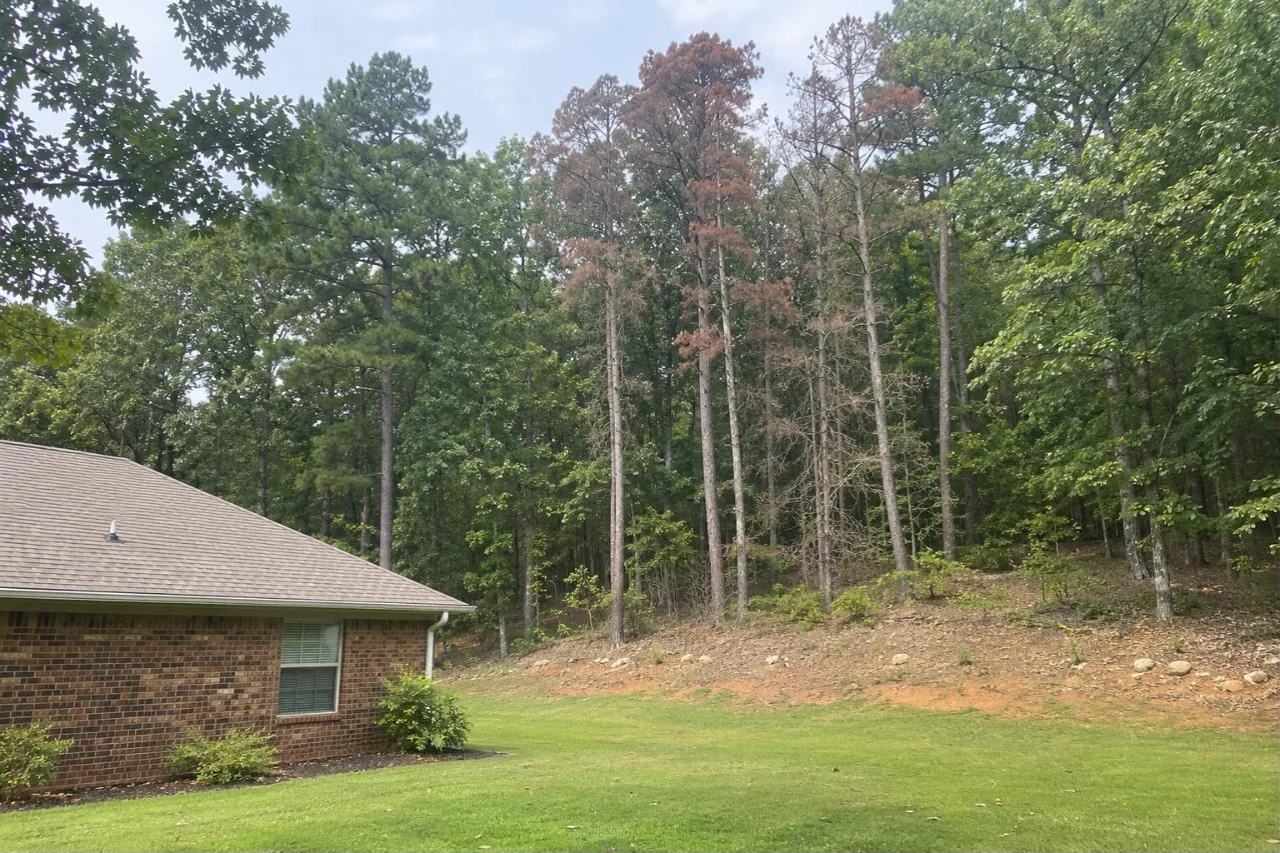
Alabama's most common tree
The USDA Forest Service's 2024 snapshot of Alabama's forests, published in March 2025, ranks loblolly pine first by volume, at 40.7%, and first by number of trees, at 21.6%. Seventy-one percent of the state's sampled land is forest. Those are statewide figures; no count of yard trees in St. Clair County was found.
What makes loblolly a removal question near houses is its size. The Forest Service's Fire Effects Information System puts a mature loblolly at 90 to 110 feet tall and 24 to 30 inches across, and says that in large trees "the lateral root spread is often greater than the crown spread." The Silvics Manual calls it a medium-lived tree; the oldest recorded, in a North Carolina stand, was 245 years, and the national champion stood 163 feet tall.
In UF/IFAS hurricane studies, loblolly lands in the medium-low group for wind resistance, sturdier than water oak or tulip poplar but well short of live oak. Those ratings come from storms on the Southeastern Coastal Plain, not this Valley and Ridge country, so treat them as a guide.
Bark beetles: which one matters
Three kinds of bark beetle attack pines here, and Alabama Extension treats them differently:
| Beetle | How Extension describes it | Its advice for a yard tree |
|---|---|---|
| Southern pine beetle | "the most destructive pine beetle in the southeastern United States"; S-shaped tunnels under the bark | Remove the tree immediately and grind the stump |
| Ips engraver beetles | "usually attack weakened or recently damaged trees"; H- or Y-shaped tunnels | Remove the tree immediately and grind the stump |
| Black turpentine beetle | "the largest bark beetle affecting southern pines" | Can be treated |
The Silvics Manual says southern pine beetle attack "may result in extensive mortality," while Ips beetles cause "death of isolated or small groups of trees." Extension also stresses that yard trees aren't timber: "the management techniques for controlling PBB are different than those implemented in rural timberlands."
What to look for
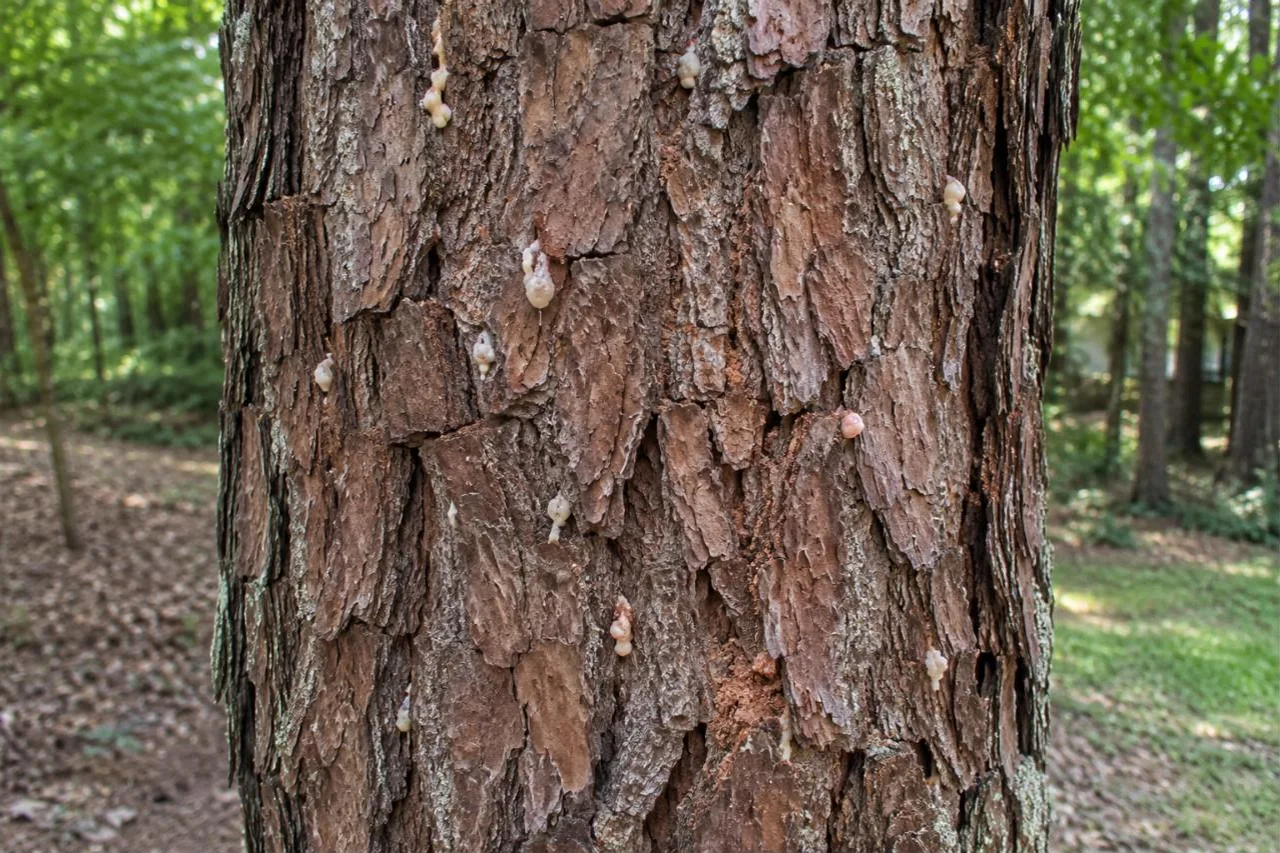
- Pitch tubes. Small lumps of dried resin on the bark, often compared to popcorn, where beetles have bored in.
- Reddish boring dust in bark crevices and at the base. On a badly stressed tree that forms no pitch tubes, it may be the main sign.
- Needles turning. Yellow first, then rusty red. The Alabama Forestry Commission says yellowing or browning needles are usually the first sign of attack people notice.
- Tunnels under loose bark, S-shaped for southern pine beetle, H- or Y-shaped for Ips.
- Pin-sized exit holes once the new beetles have left.
Why speed matters
The Forestry Commission says a complete southern pine beetle attack cycle takes 25 to 40 days depending on temperature, and that controlling one infested tree in winter "may prevent 10 trees from becoming infested the following spring." Extension says "Trees standing within 20 yards of an actively infested tree are at the greatest risk," and draws a useful line: "Dead and vacated trees might require no action, while freshly infested trees require immediate action to limit spread." A pine the beetles have already left may need no beetle action, though it can still fall on something.
What sets them off
Extension's list of the stresses that invite beetles into yard pines reads like a list of things that happen around houses:
- "Cutting roots or adding soil fill over the tops of roots within the tree's drip line," as happens with a new driveway, an addition or a septic repair.
- "Periods of prolonged drought reduce tree vigor."
- Lightning: "Strikes cause a wide range of damage to trees from immediate mortality to a loss of vigor."
- Storms: "Broken limbs cause resinous wounds that attract beetles."
Beetle numbers swing with the weather. After the 2016 drought, the USDA Forest Service's 2017 surveys counted 2,322 spots infesting 212,135 pines and said drought-related beetle infestations were killing pines throughout Alabama, "especially in the northern areas of the state," with pines on steep slopes or shallow soils especially vulnerable. By 2022, only 23 spots turned up statewide, mostly in the southwest. Extension recommends spraying high-risk pines in late winter or early spring, before beetles become active, and puts their active season at May through October.
The tallest tree on the ridge
Alabama Extension counts nearly one million cloud-to-ground lightning strikes a year in Alabama, with about 6% hitting trees, around 60,000 trees a year. "The tallest trees—single specimens in open fields or trees on hilltops—have the greatest potential for strikes" (FOR-2134, May 2023). In a forest stand, the Silvics Manual says direct losses to lightning average only about 5 trees per 100 hectares a year. A lone 100-foot pine on a ridge lot, standing above the house, is exactly the kind of tree Extension describes.
Extension's rule of thumb for a struck tree: remove it if more than about a third of the canopy is blasted away with heavy scarring, if the trunk is split, or if deep cracks run through the wood, especially near homes or driveways. Otherwise wait several weeks and watch the crown. For a pine, add one more step: treat or remove quickly, because beetles bore into lightning-weakened trees.
Snapped tops and pulled-up roots
The Silvics Manual says loblolly windthrow "is most common on shallow soils with coarse-textured profiles," that wind damage is more likely in recently thinned stands, and that the species performs worst "on shallow soils, eroded soils, and very wet or waterlogged sites." The same logic applies on a lot where the woods around a new house were recently cleared.
The Weather Service's storm surveys here keep recording pines. The tornado Tropical Storm Fay spun up in St. Clair County on August 25, 2008 mostly snapped softwood trees, and a few structures had minor damage from fallen trees. The Feb 26, 2008 Pell City–Cropwell tornado uprooted or snapped several hundred trees. A pine snapped partway up leaves a broken top hung in other trees and a jagged stub, both of which still have to come down; see storm and emergency removal.
The Silvics Manual also notes that "Greater damage frequently occurs from ice or glaze storms." Ice matters less here than wind: no ice storm with major tree damage turned up in the Weather Service's St. Clair County records.
Rust cankers and root rot
"The most serious stem disease is fusiform rust, which kills and disfigures young trees from Virginia to Texas," the Silvics Manual says, and it adds that "trees with large cankers caused by rust disease break more readily than sound trees." A canker on the trunk of a tall yard pine is worth pointing out to the contractor. The same manual notes that loblolly saplings and older trees are subject to the root disease Heterobasidion annosum "in stands where some cutting has taken place." If a group of pines is being thinned, ask the contractor how the remaining trees will be protected.
Bringing down a 100-foot pine near a house
Few yards have 100 feet of open ground in any direction, so most pine removals near a house are done in sections: limbs off from the top down, then the trunk in lengths, each piece lowered where it can't reach the roof. Where a crane can set up, it can lift sections out over the house. A few things to settle in the written price:
- The stump. After southern pine beetle or Ips, Extension says to grind it. Grinding needs an Alabama 811 request at least 2 to 10 full working days ahead (checked Nov 12, 2026). See stump grinding.
- The wood. Pell City won't collect limbs or logs a tree service cuts, and leaving them at the curb is unlawful for the contractor under Ordinance 2017-4778 (checked Nov 12, 2026). Hauling should be in the price.
- Nearby pines. If beetles are active, ask which neighbors within 20 yards look affected.
- Wires. Alabama Power says only qualified workers belong within 10 feet of a line under 50,000 volts (checked Nov 12, 2026).
| Job | Typical cost |
|---|---|
| Pine tree removal | $200 to $1,600 |
| Any tree over 80 feet | $1,200 to $2,700 |
| Pine trimming, per tree | $250 to $1,600 |
| Crane, per day, extra | $500 to $2,500 |
| Grinding the first stump | $120 to $400 |
These are national figures, not prices gathered from St. Clair County contractors. A tall pine above a house on a slope, with every piece rigged down, lands at the upper end. More on the tree removal cost page.
Keeping the rest of your pines
- Protect the roots during construction. Keep trenching, grading and fill out of the drip line where you can.
- Clean up storm damage. Broken limbs leave resinous wounds that draw beetles.
- Watch the neighbors of a dead pine. Trees within 20 yards of an active infestation are most at risk.
- Ask about prevention for high-value trees. Extension recommends spraying high-risk pines in late winter or early spring.
Loblolly questions from St. Clair County
One pine turned brown. Do the ones around it have to come down too?
Not automatically. Extension says trees within 20 yards of an actively infested tree are at the greatest risk, so have those checked for pitch tubes and boring dust. The brown one, if it's freshly infested, needs to go promptly.
Can a dead pine wait until winter?
If beetles are still in it, Extension says no: freshly infested trees need immediate action. If it died long ago and the beetles have left, beetle control may not matter, but a dead pine that could reach the house is still a falling hazard.
Lightning hit the big pine but it still looks green. Now what?
Extension's advice is to watch the crown for several weeks unless the trunk is split or deeply cracked, or a third or more of the canopy is gone. Because beetles go after lightning-weakened pines, have it checked for pitch tubes during that time.
Does it matter which kind of pine it is?
The Alabama Forestry Commission says southern pine beetle attacks all pines but prefers loblolly, shortleaf, Virginia, pond and pitch pines. For removal, height and what's underneath matter more than species.
This site has no crews and cuts no pines. A request sent from it reaches one independent contractor who works around Pell City and St. Clair County.
Source notes
- USDA Forest Service, Forests of Alabama, 2024 (FS-587, March 2025); Fire Effects Information System, Pinus taeda; Silvics Manual, Pinus taeda L. Loblolly Pine; Alabama Forest Health Highlights 2017 and 2022.
- Alabama Extension, Managing Pine Bark Beetles in Urban Forests (FOR-2049, reviewed July 2024), Bark Beetles Threatening Alabama's Forests (FOR-2200, April 2026) and Caring for Lightning-Struck Trees (FOR-2134, May 2023). Checked Nov 12, 2026.
- Alabama Forestry Commission, Southern Pine Bark Beetle. Checked Nov 12, 2026.
- UF/IFAS, Wind and Trees: Lessons Learned from Hurricanes (FR173).
- NWS Birmingham, Tropical Storm Fay St. Clair tornado and Pell City-Cropwell Tornado. Checked Nov 12, 2026.
- Alabama 811, al811.com; City of Pell City, Ordinance No. 2017-4778; Alabama Power, Residential Vegetation Management; HomeGuide, Tree Removal Cost, Tree Trimming Cost and Stump Grinding Cost. Checked Nov 12, 2026.