
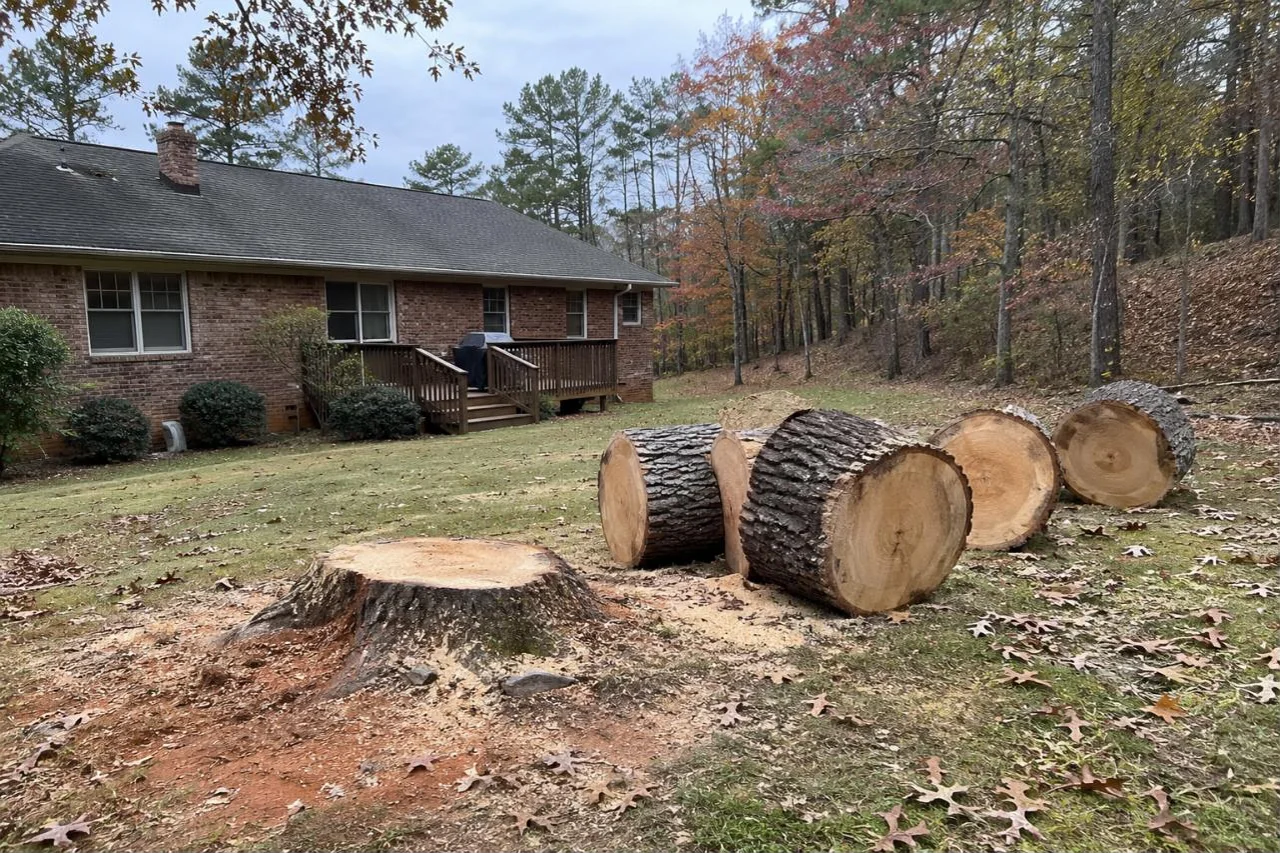
What the crew actually does
Most removals follow the same order, whatever the tree:
- A walk around the tree. The contractor looks at the lean, dead wood in the crown, the ground at the base, and everything the trunk could reach: the house, a deck, a fence, a shed, the line to the house.
- Choosing how it comes down. Felled whole, taken apart in pieces, or lifted out by crane. The next section explains the difference.
- Limbs first. On a sectioned job a climber or a bucket truck takes off the limbs, tying off any that hang over something breakable.
- The trunk in lengths. The trunk comes down from the top in pieces short enough to control.
- Cleanup. Brush goes through the chipper, the trunk is cut into rounds, and the wood is hauled or left where you asked.
- The stump, if you want it gone. Grinding is usually its own line on the price, and it means a call to Alabama 811 first.
A written price should say which of these steps it covers. The word "removal" by itself can mean a stump left at knee height and a pile of logs on the lawn.
Felled, sectioned or craned
A tree can be dropped in one piece only where there's clear ground in its path longer than the tree is tall. Trees here get big. The USDA Forest Service's Fire Effects Information System puts mature loblolly pine at 90 to 110 feet, and notes that in large trees the roots often spread wider than the crown. UF/IFAS lists water oak at 50 to 60 feet tall with a 60- to 70-foot spread. Behind a ranch house with a deck and a neighbor's shed, that much open ground rarely exists, so most yard removals are done in sections.
- Felling whole. A wedge is cut facing the direction of fall, a back cut follows from behind, and the trunk tips over along that line. It suits open pasture and acreage far better than a backyard.
- Taking it down in sections. A climber or a bucket truck works from the top down. Pieces over a roof, a deck or a fence are tied to a rope and lowered under control.
- Crane removal. If a large trunk hangs over the roof and rope lowering would be too risky, a crane can hoist sections up and away. HomeGuide lists crane-assisted removal at $500 to $2,500 a day on top of the removal itself (checked Nov 12, 2026). A crane needs a firm, fairly level spot to set its outriggers, which a steep driveway or soaked clay may not give it.
Ask the crew which method they'll use and where the pieces are headed. A good answer points to a spot on the ground and explains how the deck, fence or roof beside it stays protected.
Sloping lots, red clay and ridge rock
St. Clair County lies at the southern tip of the Appalachian Mountains. The Encyclopedia of Alabama describes fertile limestone soils in its valleys and acidic sandstone soils on its ridges, with Backbone Mountain splitting the county. Alabama Extension's soil guide describes the state's limestone valley region as having "red clayey soils with silt loam surface textures." In this ridge country, a yard that falls away behind the house into the woods is a common setup.
A slope changes a removal in several ways:
- Logs roll. A round cut loose on a hill heads downhill. Pieces get lowered and staged so they can't run into a deck, a fence or the house below.
- Trucks need level ground. If a bucket truck can't reach the tree, the job is climbed and rigged by hand, which takes longer.
- Brush travels uphill. The chipper often stays on the street, and every limb gets dragged up to it.
- Wet clay is slick. A loaded truck can rut a lawn after rain, so crews may lay ground mats or wait for a dry spell.
Low ground has its own problem. The Tanyard soil series, whose official type location is about 2.5 miles northwest of Pell City, lies on flood plains and stream terraces and holds a water table 1.5 to 2.5 feet below the surface in winter and early spring (USDA soil series description). In a wet creek bottom in February, heavy equipment may have to wait.
Who has to say yes
For an ordinary tree on an existing house lot, only you, as far as this site's research reached. No homeowner tree permit turned up in Pell City's posted Land Use Regulations (the 2022 update), Moody's zoning code, Odenville's development regulations, or the local laws compiled for St. Clair County (checked Nov 12, 2026). The exceptions:
- The Logan Martin shoreline. On Alabama Power's land at the water, the 15-foot buffer bars removing any tree more than 3 inches in diameter without the company's written authorization. See trees on Logan Martin lake lots.
- Springville. The city's zoning ordinance takes in "Guidelines for Tree Conservation and Landscape Planting," adopted February 6, 2006, which couldn't be read for this site. Ask the city before cutting.
- Ashville, Riverside, Margaret, Ragland, Argo and Steele. Their rules weren't researched for this site; a call to town hall settles it.
- A county road. The county Road Department posts a permit form for work in county right-of-way. If the trunk stands beside a county road, call 205-594-2190 first (checked Nov 12, 2026).
- Your neighbor's tree. Under Ala. Code § 35-14-1, a person who willfully and knowingly cuts trees on land that isn't theirs, without the owner's consent, owes the owner a set sum per tree: $20 for listed species that include oaks and pines, $10 for others (2025 Code of Alabama, checked Nov 12, 2026). Settle where the line runs before the saw starts.
- Your homeowners association. Lake subdivisions and newer neighborhoods may have covenants about trees. Read them before booking the work.
The Pell City tree rules guide has each of these with its source and phone number.
Trees near Alabama Power lines
Alabama Power, the electric company the City of Pell City lists for new residents, says an unqualified person should not work within 10 feet of overhead power lines carrying less than 50,000 volts, pointing to OSHA and the ANSI Z133 tree-care safety standard, and that pruning around power lines should be left to qualified professionals (checked Nov 12, 2026). Along the distribution lines that run through neighborhoods, the company generally maintains a 30-foot-wide easement, 15 feet on each side, and trims only where it has a legal right and believes the work is needed.
Its vegetation page is silent on limbs around the service drop, the single wire that runs from the pole to the house. Ask Alabama Power before the removal is scheduled. If a tree is already down on a line, stay away from it and call 1-800-888-2726 (checked Nov 12, 2026). The company's own safety page says not to try removing limbs or anything else from a downed line.
Getting the wood off the lot
This is where Pell City is stricter than many places. The city's garbage ordinance, No. 2017-4778, makes it unlawful for a tree removal contractor or landscaper to leave tree or limb debris at the curb for the city to remove, and it says the city doesn't collect limbs and trimmings from tree service contractors or land clearing at all. A violation is a misdemeanor with a fine of $50 to $200, and each day counts as a separate offense (checked Nov 12, 2026).
The city's brush pickup, run by Meridian Waste, is meant for residents' own yard waste:
| Rule | What the city says |
|---|---|
| How often | Every other week, on your regular garbage day |
| How much | Up to 6 cubic yards, a pile about 9 feet long, 6 feet wide and 3 feet high |
| Piece size | Under 5 feet long and under 6 inches thick |
| Placement | Between the sidewalk and the curb; not under trees or low wires, not between a pole and its support cable, not by a hydrant, fence or building |
| Leaves and grass | Bagged |
| Not taken | Material from a contractor, landscaper or tree service, or from clearing a lot |
The city's drop-off site for residents won't take brush or yard debris either. So a removal's trunk and limbs leave on the contractor's truck, get chipped and spread on your property, or stay behind as firewood. Outside city limits, Pell City's page points people to Arrow Disposal Services, and Meridian Waste lists tree branches among the yard waste it handles in St. Clair County, with no size limits stated (checked Nov 12, 2026).
Burning runs into state air rules. ADEM's open-burning rule for vegetation requires the fire to sit at least 500 feet from the nearest occupied dwelling, start between 8 a.m. and 3 p.m., be attended the whole time, and burn only vegetation and untreated wood from that same property (Ala. Admin. Code r. 335-3-3-.01, checked Nov 12, 2026). The rules guide covers the Forestry Commission's burn permits too.
The stump
Ask whether grinding is in the price or a separate line. HomeGuide's national figure for grinding the first stump is $120 to $400 (checked Nov 12, 2026). Alabama 811 asks for notice at least 2 to 10 full working days before digging. For a pine infested with southern pine beetle or Ips engraver beetles, Alabama Extension's advice is plain: "Remove the tree immediately and grind the stump." The stump grinding guide covers the rest.
Removal price ranges
These are national figures. No price page for Pell City, Birmingham, Leeds or Trussville could be read for this site, and none was collected from local contractors.
| Tree height | Typical cost |
|---|---|
| Under 30 feet | $150 to $500 |
| 30 to 60 feet | $300 to $1,000 |
| 60 to 80 feet | $650 to $2,000 |
| Over 80 feet | $1,200 to $2,700 |
HomeGuide also lists pine removal at $200 to $1,600 and oak removal at $250 to $2,500 on average. Angi puts the average at $750, with most people paying $200 to $2,000 (both checked Nov 12, 2026). Every tier, with trimming, grinding and storm rates, is on the tree removal cost page.
Removal questions from St. Clair County
Can the crew leave the logs at the curb for the city?
No. In Pell City that's a misdemeanor for the contractor under Ordinance 2017-4778, and the city's pickup won't take material from a tree service anyway (checked Nov 12, 2026). Make sure the written price says who hauls the wood and where it goes.
The tree is uphill from the house. Does that change things?
Yes. Anything cut loose above the house wants to travel toward it, so pieces get tied off and lowered and the rounds are staged where they can't roll. Expect it to take longer than the same tree on flat ground.
Will homeowner's insurance pay for the removal?
The Alabama Department of Insurance says a homeowners policy generally covers up to $500 toward tree removal, and that limit applies to all the downed trees from one event, not to each tree. If the tree damaged the house or another insured structure, removing it from that structure falls under the dwelling part of the policy (checked Nov 12, 2026). Your own policy and your agent have the final word.
Can I keep the wood?
Usually, yes. Ask the crew to cut the trunk into firewood-length rounds and stack them, or to leave chips for your beds. Less to haul can mean a lower price.
There's a dead tree right at the water on my lake lot. Can it just come down?
Not without asking Alabama Power first if it stands inside the 15-foot buffer on the company's land. The guidelines list no exception for dead trees. Call the Logan Martin Lake Office at 205-472-0481 (checked Nov 12, 2026).
The site itself cuts no trees. Requests made here go to one independent contractor working in Pell City and St. Clair County.
Source notes
- HomeGuide, Tree Removal Cost; Angi, How Much Does Tree Removal Cost? Both checked Nov 12, 2026.
- Encyclopedia of Alabama, St. Clair County, last updated February 6, 2026; Alabama Extension, Soils of Alabama (ANR-0340, reviewed July 2018); USDA official soil series description, Tanyard.
- USDA Forest Service Fire Effects Information System, Pinus taeda; UF/IFAS, Quercus nigra: Water Oak (ST553).
- City of Pell City, Ordinance No. 2017-4778, Solid Waste Disposal and Land Use Regulations, 2022 Update; Meridian Waste, St. Clair County. Checked Nov 12, 2026.
- Moody zoning code (third-party copy at Zoneomics); City of Odenville, Subdivision and Development Regulations; City of Springville, Zoning Ordinance; Alabama Legislative Services, St. Clair County local laws; St. Clair County, County Engineer / Road Department. Checked Nov 12, 2026.
- Alabama Power, Trees and Rights of Way, Residential Vegetation Management and Power Line Safety; City of Pell City, New to Pell City. Checked Nov 12, 2026.
- Ala. Admin. Code r. 335-3-3-.01 (open burning); Ala. Code § 35-14-1 (2025 Code); Alabama 811, al811.com; Alabama Extension, Managing Pine Bark Beetles in Urban Forests (FOR-2049); Alabama Department of Insurance, An Insurance Preparedness Guide for Natural Disasters. Checked Nov 12, 2026.