
Alabama 811 comes first
A stump grinder doesn't stop at the surface. Its cutting wheel chews down into the ground and through the roots around the stump, and a gas line, a buried power cable or a phone or fiber line can run right through that space. Alabama 811 is the state's one-call center for locating them. Its site says (checked Nov 12, 2026):
- Give notice at least 2 to 10 full working days before you start.
- Submit the request online or call 811. Its other listed numbers are 800-292-8525 and, in the Birmingham area, 205-252-4444.
- Online requests that come in after 4:30 p.m. on a weekday may be handled the next business day.
- Utility companies mark their own lines. Alabama 811 itself does not mark anything.
- "Anyone who plans to dig should contact 811," and "Locate requests are required by law before excavation."
The law behind it is Title 37, Chapter 15 of the Code of Alabama. Its definition of excavation covers any operation that moves or removes earth, rock or other material with mechanized equipment, and lists augering, boring, digging, ditching and grading among others (§ 37-15-2, checked Nov 12, 2026). Stump grinding isn't named, but a machine grinding a stump below grade is moving earth. Call before grinding.
If you know of buried lines that don't belong to a utility, such as a sprinkler line, a septic line or a wire run out to a shed or a dock, show the contractor where they go. And agree in writing who places the 811 request.
How the job goes
A stump grinder is a heavy cutting wheel lined with teeth that swings side to side across the stump, turning wood into chips a little at a time. The small walk-behind machines fit through a backyard gate and handle many residential stumps; bigger towed or tracked grinders take on wide stumps but need room to get in.
Things to settle before the machine arrives:
- How deep. Ask how far below the surface the grinder will go. Planting grass needs less depth than putting a bed, a patio or a new tree in the same spot.
- Surface roots. Grinding the stump alone leaves the roots that run out from it. Ask whether the big surface roots are included.
- Access. Gate width, steps, a slope down to the stump or a soft lawn all decide which machine can reach it.
- The chips. Left in the hole, spread on beds, or hauled away. See below.
Digging a stump out entirely, roots and all, is the other route. HomeGuide lists it at $80 to $190 per stump, and says contractors charge a $150 to $350 minimum just to bring out a backhoe (checked Nov 12, 2026). Digging leaves a bigger hole and disturbs more of the yard, but it does take the whole root crown.
Rock in the clay
The Encyclopedia of Alabama describes St. Clair County's valleys as fertile limestone soils and its ridges as acidic sandstone soils. On the ridges especially, the ground can be thin. Soil series found in the surrounding Valley and Ridge country, though not confirmed as mapped in St. Clair County, run shallow to rock: the USDA's official descriptions put Montevallo soils at 10 to 20 inches to bedrock, Gorgas soils at 10 to 20 inches to hard sandstone, and Townley and Firestone soils at 20 to 40 inches. Firestone's subsoil is 60 to 75 percent clay.
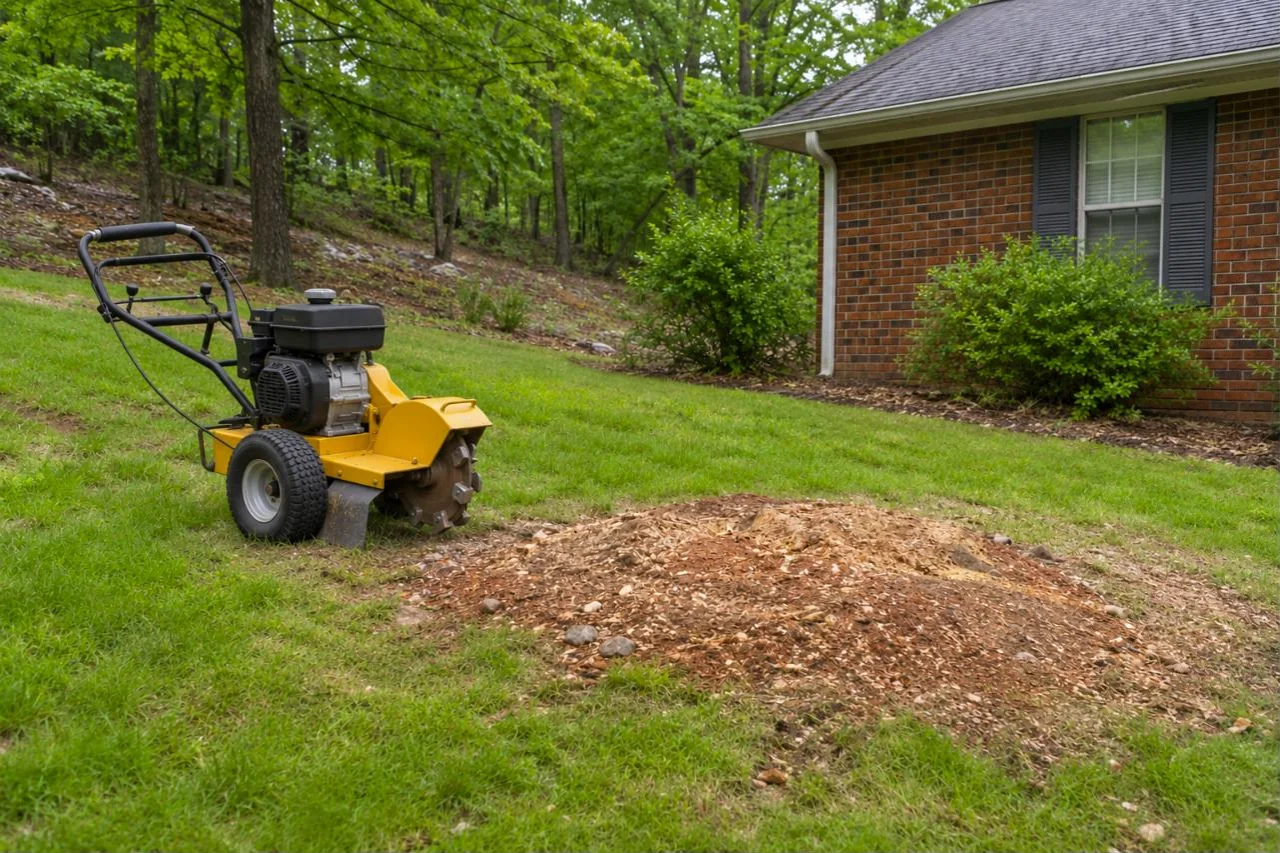
For a grinder that means rocks wrapped in the root crown and pressed into the clay around it. Grinder teeth that hit stone dull or break, and the operator slows down to work around it. The chips that come out are often mixed with clay and rock, as in the photo above, which makes them poor mulch. Mention rocky ground when you describe the stump.
On low ground near creeks the problem flips. The Tanyard soil, whose official type location is near Pell City, holds a water table 1.5 to 2.5 feet down in winter and early spring (USDA soil series description). A grinder can sink or rut a wet yard then, and a dry week is the better time.
Pine stumps after beetles
When southern pine beetle or Ips engraver beetles infest a pine, Alabama Extension's advice for urban trees is direct: "Remove the tree immediately and grind the stump." The same guide says trees standing within 20 yards of an actively infested tree are at the greatest risk, and that freshly infested trees need immediate action to limit spread, while dead trees the beetles have already left may need no beetle action at all (Alabama Extension FOR-2049, reviewed July 2024). Black turpentine beetle, the one exception it names, can be treated.
The USDA's Silvics Manual adds that loblolly saplings and older trees are subject to attack by the root disease Heterobasidion annosum "in stands where some cutting has taken place." If several pines are coming down near ones you want to keep, ask the contractor about it. The loblolly pine guide covers the beetles in detail.
A stump at the water's edge
On a Logan Martin lot, the first 15 feet back from full pool on Alabama Power's land is a natural buffer. The company's guidelines list "changing the contour of the land" among the activities not permitted there, along with "allowing the presence of any garbage, debris, or other foreign material," and they say no construction or related activity may take place in the buffer without Alabama Power's prior written authorization (revised July 15, 2025, checked Nov 12, 2026).
Grinding a stump below grade inside that strip, and leaving a mound of chips, could run into both lines. Before a grinder goes near the shoreline, call the Logan Martin Lake Office at 205-472-0481 (checked Nov 12, 2026). The lake lot guide explains who owns that land.
What to do with the chips
- Back into the hole. The simplest choice. The chips settle and break down, so the spot sinks over time and needs topping up with soil.
- Hauled off and replaced with soil. Better if you want grass to grow there soon. Ask for it in the price.
- Spread as mulch. Clean wood chips work around shrubs. Chips full of clay and rock, less so.
Inside Pell City, don't count on the curb. The city's brush service doesn't take material generated by a contractor or tree service, and leaves and similar loose yard material must be bagged (checked Nov 12, 2026).
Grinding prices by stump width
HomeGuide's stump grinding guide gives $120 to $400 for the first stump, $30 to $60 for each additional one, and $2 to $6 per inch of diameter, with minimum service charges of $80 to $160 (checked Nov 12, 2026). Its per-stump figures by width, before those minimums:
| Stump diameter | Typical cost |
|---|---|
| Up to 12 inches | $30 to $70 |
| 24 inches | $50 to $150 |
| 36 inches | $70 to $220 |
| 48 inches | $100 to $290 |
| 60 inches | $120 to $360 |
| 72 inches | $150 to $430 |
When the stump is part of a removal, Angi suggests budgeting $100 to $150 more for it (checked Nov 12, 2026). These are national averages, not St. Clair County prices. Rock, a slope, a tight gate or a long haul for the chips all push a local price up; the contractor's written number is the one to go by.
Stump grinding questions around Pell City
Is an 811 call really needed for one stump?
Alabama 811 says anyone who plans to dig should contact it and that locate requests are required by law before excavation (checked Nov 12, 2026). A grinder works below the surface, so yes. Allow at least 2 to 10 full working days.
Can I just leave the stump?
Often, yes. An old hardwood stump in the back corner of the lot can stay. A pine stump left after southern pine beetle or Ips is the exception: Alabama Extension's advice is to remove the tree immediately and grind the stump.
How soon after the tree comes down can the stump be ground?
Any time. Doing it alongside the removal settles the crew and the price at once, but a stump left from years ago grinds the same way.
Will Pell City pick up the chips?
Not if a contractor made them. The city's brush service doesn't accept contractor or tree service material (checked Nov 12, 2026). Leave them in the hole, spread them, or have them hauled.
This site has no grinders and does no tree work. A request sent from it reaches one independent contractor who works in St. Clair County.
Source notes
- Alabama 811, al811.com; Code of Alabama Title 37, Chapter 15, Notification of Excavation or Demolition Operations, and § 37-15-2. Checked Nov 12, 2026.
- Encyclopedia of Alabama, St. Clair County, last updated February 6, 2026; USDA official soil series descriptions: Montevallo, Gorgas, Townley, Firestone and Tanyard.
- Alabama Extension, Managing Pine Bark Beetles in Urban Forests (FOR-2049, reviewed July 2024); USDA Silvics Manual, Pinus taeda L. Loblolly Pine.
- Alabama Power, General Guidelines for Residential Shoreline Permitting, Lakes Neely Henry and Logan Martin, revised July 15, 2025, and shoreline contacts. Checked Nov 12, 2026.
- City of Pell City, Solid Waste Disposal. Checked Nov 12, 2026.
- HomeGuide, Stump Grinding Cost; Angi, How Much Does Tree Removal Cost? Both checked Nov 12, 2026.